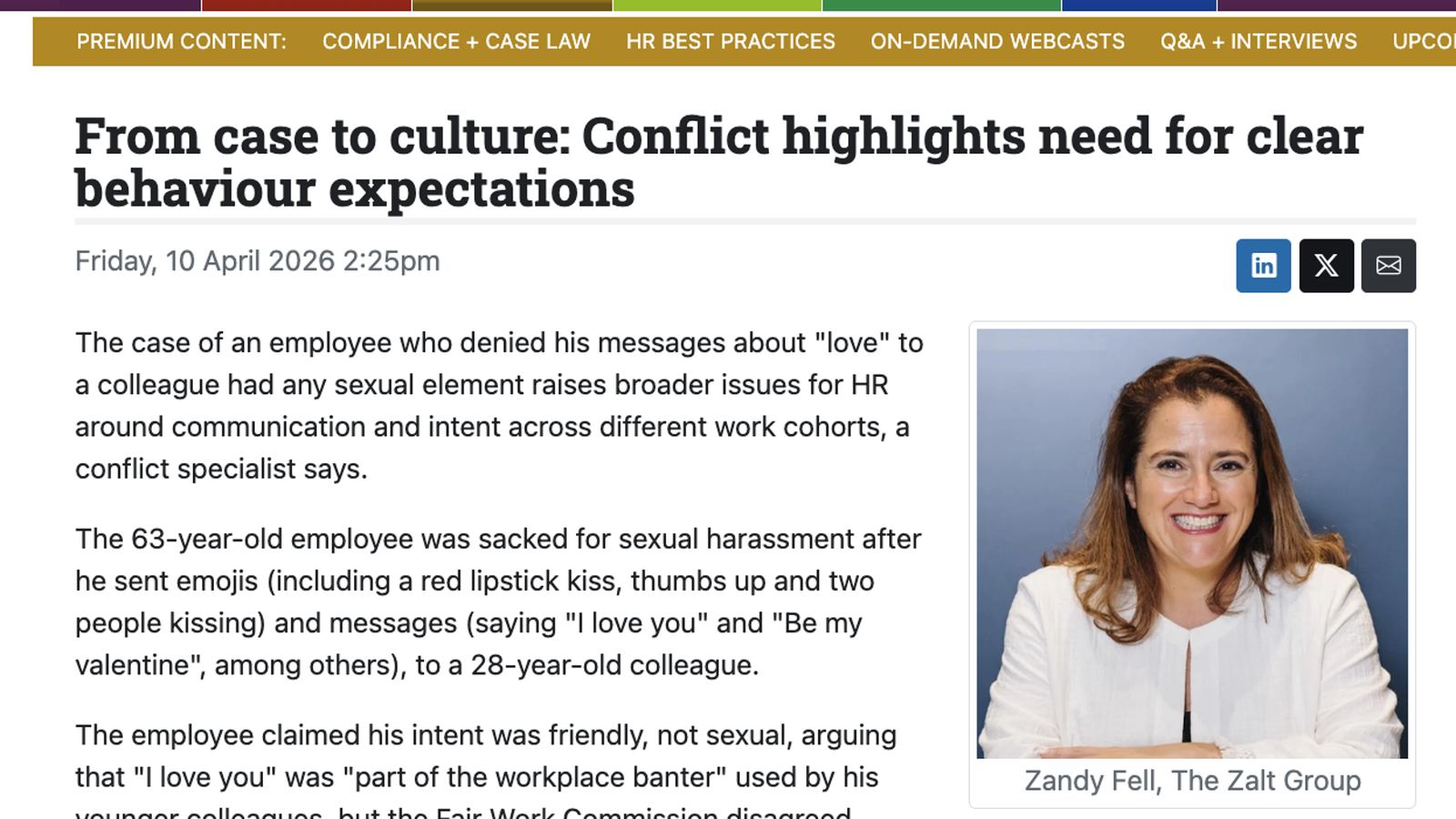
Article Excerpt from Zandy Fell’s HR Daily Interview:
The case of an employee who denied his messages about “love” to a colleague had any sexual element raises broader issues for HR around communication and intent across different work cohorts, a conflict specialist says. The 63-year-old employee was sacked for sexual harassment after he sent emojis (including a red lipstick kiss, thumbs up and two people kissing) and messages (saying “I love you” and “Be my Valentine”, among others) to a 28-year-old colleague. The employee claimed his intent was friendly, not sexual, arguing that “I love you” was “part of the workplace banter” used by his younger colleagues, but the Fair Work Commission disagreed.
According to The Zalt Group Director Zandy Fell, , it’s not uncommon for misunderstandings to arise when there’s an “intergenerational layer” to workplace interactions.
She also recalls a case where “LOL” was misinterpreted by a more senior employee as “lots of love”(instead of its intended “laugh out loud”), leading him to behave in ways his younger colleague considered inappropriate. Intergenerational conflict is often misdiagnosed as a values clash, Fell tells HR Daily.
Sometimes, however, it’s a signal that shifting norms are giving rise to different expectations, and it’s actually a clash of interpretations.
Such clashes aren’t always generational, she says, but some friction is inevitable when different generations in the workplace grew up and were socialised in different times.
“What ‘good behaviour’ looks like is overlaid with your thoughts on power and respect and boundaries,” Fell explains. For example, one cohort joined the workplace when the norm was “respect authority, don’t make a fuss”, the next was told to “speak up and challenge”, and the following two were told, “psychological safety is a right”!
Closing the gap between intention and perception
In any type of interpersonal workplace conflict or clash, it’s crucial for the parties to understand the other person’s intent, and why it wasn’t perceived that way, Fell says.
She gives the example of a senior leader who gave an employee feedback along the lines of, “You need to toughen up, this isn’t personal”.
That particular leader genuinely intended clarity for the employee’s sake, Fell says, “but it landed as dismissive, and then the employee was saying, ‘I feel unsafe'”.
Beyond generational differences, another factor to bear in mind is that perspectives on what constitutes respectful conduct can differ depending on influences such as an employee’s upbringing.
It’s why clarifying what acceptable workplace behaviour is, and what isn’t, can be such an effective preventive measure, Fell says. Make “the implicit explicit,” she urges. Define “respectful”, and also “what
crosses the line”.
Cultivate the ability to “pull out someone’s intent.”
It helps to have leaders who can “pull out someone’s intent” and initiate an “exchange of intention and impact” between parties, as sharing the impact both ways will often de-escalate a situation.
In the case of an employee perceiving an attempt at constructive clarity from their manager as dismissive, “a good leader would be able to bridge the gap, without shame and without shutting down”, Fell says. They’d be able to say to the manager, “Okay, that didn’t land well, what did you actually intend?” The manager might then say, “I wanted them to know that they needed to step up in this situation, and that they need to focus on the content, and push aside the emotion a bit “, while the employee might say they thought it was a “personal attack” on their integrity.
The leader could then ask questions about how the employee would prefer to receive the feedback, and bridge the gap between the manager’s intent and impact.
Returning to the manager, the leader might say, “I can see what you intended, but I also need you to understand how that landed, particularly given your role”, and suggest, “If we could turn back time, let’s rework it together”. “That’s work, that takes time… to step outside [and] hold the relationships intact. There’s real skill there,” Fell says. External consultants can help, she says, but in an ideal world, a third party wouldn’t be needed; one or both of the people most directly involved in the conversation would “pick up on a vibe that something didn’t land” and unpack that together.
Choosing words wisely
Fell also recalls an incident where a manager told her subordinate, “You came across a bit emotional in that presentation, and you need to be more composed”.
The manager saw it as performance coaching, “but the employee experienced that as publicly undermining and gendered”, Fell says.
“The leader was drawing from an older norm… believing that direct feedback is helpful, but the employee was applying a newer lens of impact and power.
“Context matters, and so when that one escalated, the manager felt like they were being accused of something they didn’t mean,” she says.
“Again, if we talk about bridging… the move isn’t to retreat from the feedback, but to deliver it in a way that holds both that clarity and dignity. In that case, there is a generational lens in it, but it’s also back to basics: You need to change your message depending on who you’re giving it to.
“And if you know that someone sees things a little bit differently, then you should choose your words wisely.” Be “more deliberate than ever” about how culture is lived HR leaders can help to prevent conflict by being “more deliberate than ever” about how culture is defined and lived, Fell says. “You can’t define everything; you can’t put everything into black and white categories of ‘that’s okay ‘ and ‘that’s not okay’,” she acknowledges. But HR can educate their workforce on those different frames of reference that people bring to the workplace, including the fact that they might have completely different definitions of, for example, what the word “coaching” means, which leads to completely different expectations.
Something as simple as what “coaching” or “feedback” is meant to involve might need to be deliberately”infused” into both manager and employee thinking, Fell says.
“If that’s not done, then a manager and employee should talk about what coaching [or feedback] means,” she says. The manager could sit down with the employee, ideally
early in their relationship, or at the beginning of a new year or project or cycle, and say, “What does feedback mean to you? What’s your preferred way of getting it?”