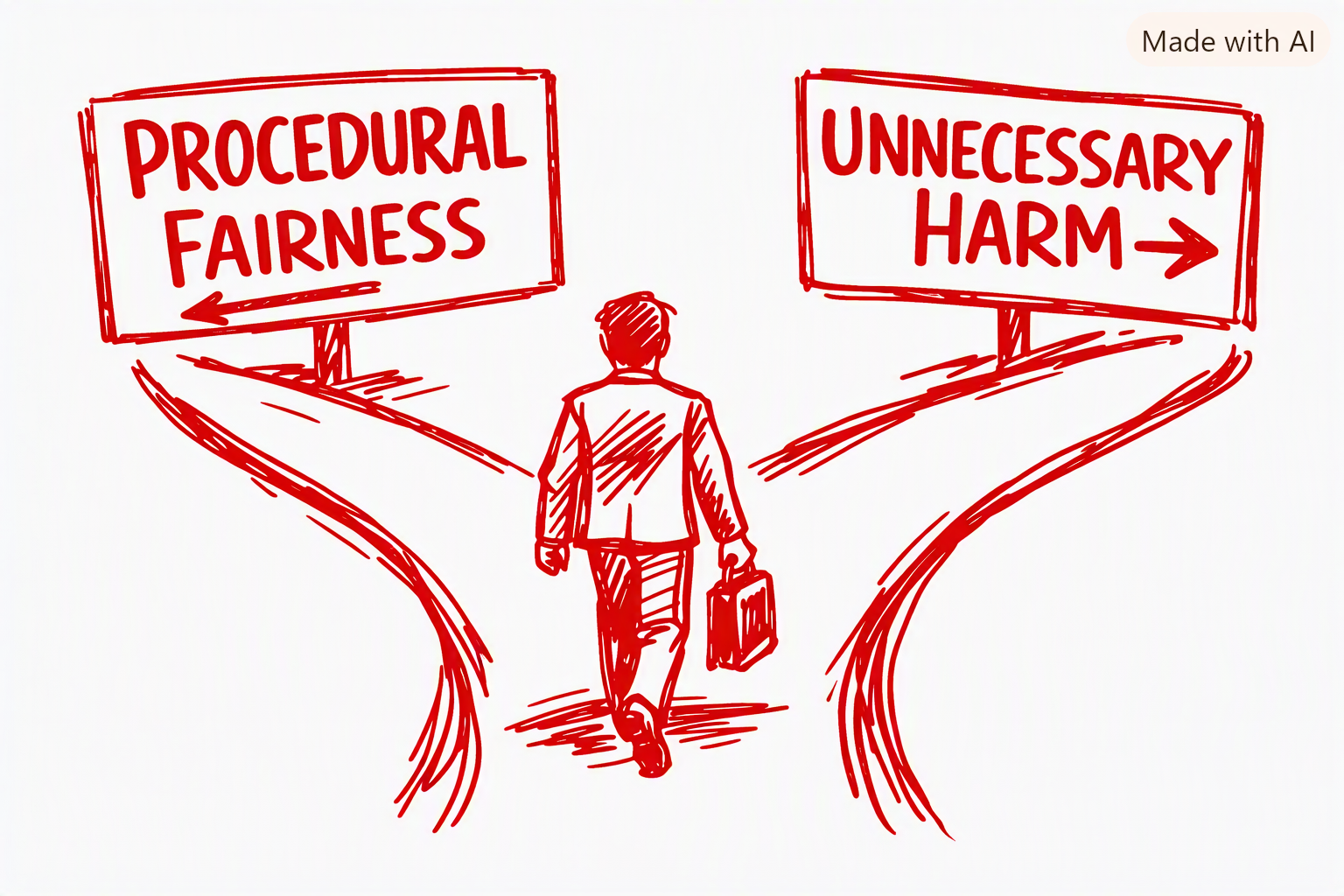
Do you know the difference between NECESSARY DIFFICULTY and UNNECCESSARY HARM?
I was recently mentoring an investigator who was dealing with a difficult issue. A complainant, Jane, was becoming increasingly distressed through the investigation process, particularly as aspects of their account were being tested. The respondent, Geraldine, had provided a materially different version of events and some of that evidence needed to be put back to the complainant. The investigator was understandably concerned about the impact of doing so on Jane.
The investigation still needed to establish what had occurred and the Geraldine was entitled to a fair process. It raised a broader question: when does the investigation itself become a psychosocial hazard?

The process can have consequences!
We usually see an investigation as the organisation’s response to a workplace problem. However, once commenced, the investigation becomes an organisational intervention in its own right. It creates uncertainty, changes relationships and requires people to participate in a process that may have significant consequences.
A complainant may need to revisit difficult events, have their recollection tested and hear an account fundamentally different from their own. A respondent may suddenly learn that serious allegations have been made against them and face uncertainty about their employment, reputation and relationships before any finding has been made. Witnesses can also become caught in the middle, concerned about confidentiality, relationships and the consequences of giving evidence.
The investigation can create a potential psychosocial risks and compound them. What reduces risk for one participant may increase it for another.
Procedural fairness can itself be difficult
This is where it becomes more complex. Some of the very things that can cause distress are also things required by a fair investigation.
In the matter I was discussing, simply deciding not to put the Geraldines ‘s evidence to the complainant would have been easier for Jane. But it would have left important evidence untested. Equally, the investigation could not simply press ahead without considering the impact on the complainant.
A trauma-informed approach does not mean evidence cannot be challenged. Procedural fairness does not require every difficult question to be asked in the most direct or confronting way possible.
Necessary difficulty or unnecessary harm?
For me, this is the more useful distinction. We worked through why the investigator needed the information, what genuinely needed to be tested and how best to do that. Did everything need to be dealt with in one interview? Could the complainant be told beforehand that some difficult issues needed to be explored? Was every question necessary? Could some matters be established through other evidence? None of this changed the evidentiary task. It changed how we approached it.
An investigator should not avoid a necessary question because it may cause distress. But neither should we assume that because something is procedurally necessary, asking the usual question in the usual manner is the only way.
Fairness and trauma-informed practice run in all directions
There is a danger that the person displaying the greatest distress understandably commands our attention. However, psychosocial risk and fairness need to be considered across the investigation.
Trauma-informed practice is important, but it does not mean removing difficult aspects of an investigation or diminishing the rights of other participants. At its heart, it is often about providing greater predictability, control and choice where that can reasonably occur. A participant might be given greater clarity about what will happen next, some choice about timing or breaks, or an explanation about why a difficult area needs to be explored. These things can provide a greater sense of control without changing the evidence that needs to be tested or the procedural fairness owed to the respondent.
The same thinking applies to all participants. A complainant is entitled to be treated carefully and respectfully, but a respondent may also experience significant harm simply from being the subject of serious allegations. A respondent is entitled to procedural fairness, but that does not justify unnecessarily exposing a complainant to repeated or irrelevant questioning. Witnesses should not become collateral damage.
There will rarely be a perfect solution. Additional time may assist one participant while prolonging another’s uncertainty. Limiting information may protect one person while making it harder for another to properly respond. Asking a question may cause distress; not asking it may undermine the reliability of the eventual finding.

This is where investigator judgement matters
Good investigation practice is not about choosing between psychological safety and procedural fairness. It is about understanding what a fair and reliable investigation requires, recognising the foreseeable impact on all participants, and considering whether that impact is necessary or can reasonably be reduced without compromising the investigation.
That requires more than knowing the steps in an investigation process. It requires judgement: knowing what to ask and why, when to persist, when the process can be adapted and when an uncomfortable part of the investigation simply cannot be avoided.
A good investigator needs to know the difference between necessary difficulty and unnecessary harm.